
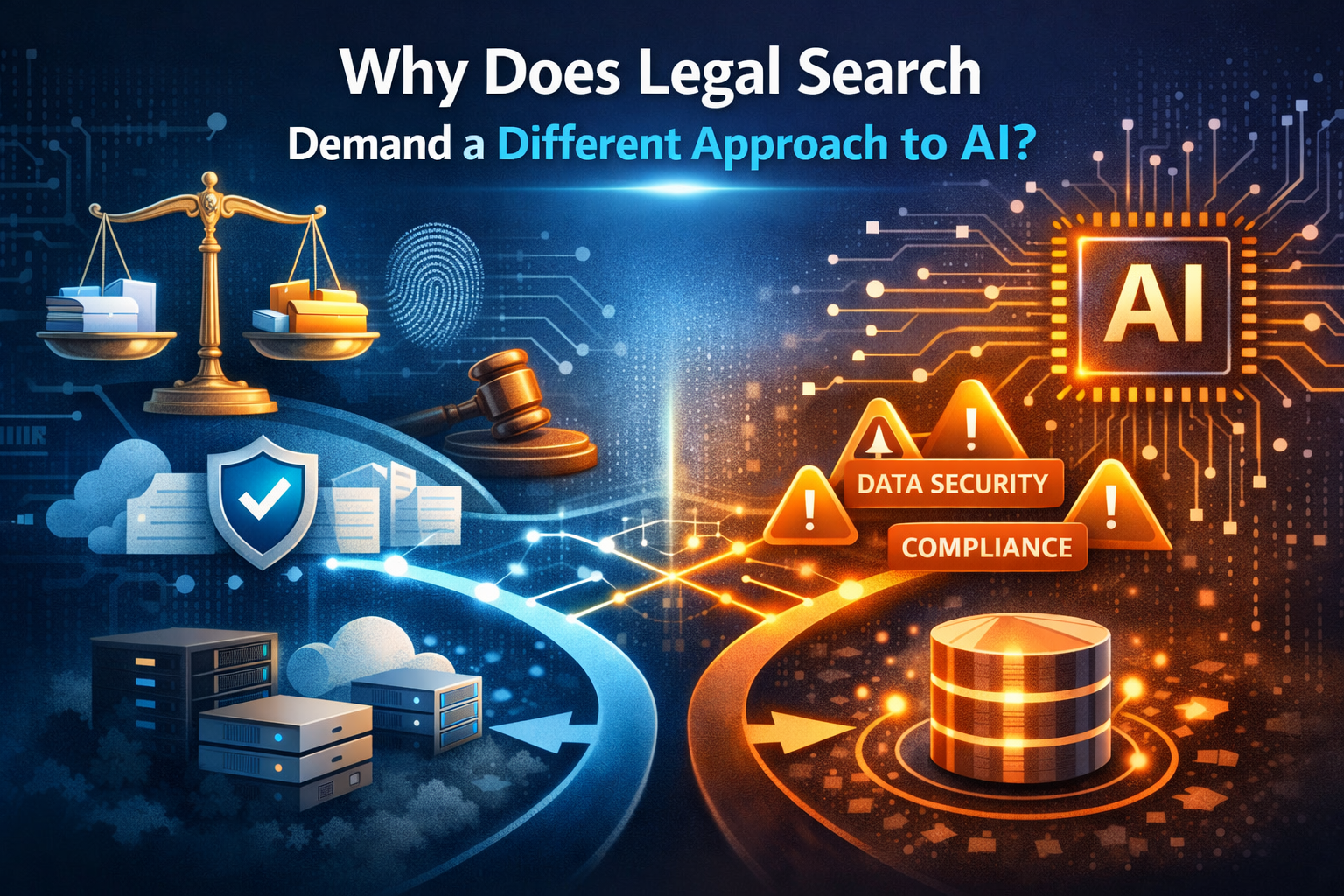
Enterprise AI is evolving rapidly. Models are becoming more capable. Interfaces are becoming more conversational. Expectations are rising across every function especially for legal teams. As adoption accelerates, so does a more sobering realization: AI success in the enterprise is defined less by model intelligence than by system architecture.
This reality is particularly visible in legal environments.
Legal professionals are not simply evaluating whether AI is useful. They are evaluating whether it can be trusted within frameworks of security, governance, compliance, defensibility, and risk.
Many early legal AI deployments have revealed a familiar set of concerns: hallucinated answers, opaque reasoning, uncertainty around data exposure, and architectures that require copying or re-indexing sensitive content.
In legal contexts, these are not minor technical issues. They are barriers to adoption.
Rethinking the Architecture of Legal AI
A significant portion of the legal AI landscape relies on a common architectural pattern: ingesting, indexing, or copying enterprise data into new, centralized AI-controlled repositories.
While this approach can simplify model interaction, it introduces new complexities, particularly in legal environments:
- Data duplication and movement
- Governance and compliance challenges
- Permission inconsistencies
- Expanded security and risk surfaces
For legal organizations, where confidentiality, provenance, and defensibility are paramount, these trade-offs can be difficult to justify.
SWIRL represents a fundamentally different architectural model.
Instead of moving or rebuilding data, SWIRL federates across existing systems, preserves permission integrity, and improves outcomes through intelligent re-ranking and controlled AI interaction.
The difference is not incremental. It is architectural.
SWIRL AI Legal Search was designed around this philosophy.
Rather than layering trust, security, and governance onto AI after the fact, SWIRL treats them as design constraints from the start. The result is a system grounded in four core principles.
- Trustworthy by Architecture
In legal environments, trust cannot depend on policy alone. It must be enforced by design.
SWIRL operates privately, deployed on premises or in a private cloud, ensuring sensitive client and matter data never flows through hosted third-party systems.
Security remains permission-faithful. SWIRL integrates directly with existing identity providers and enforces access controls exactly as defined across connected platforms.
Compliance is preserved through zero data movement. No ingestion. No indexing. No copying content into new AI-controlled repositories.
Rather than introducing new data risk, SWIRL preserves the integrity of existing legal information environments.
- Built for Enterprise Reality
Legal AI must align with how enterprises govern technology.
SWIRL is installed, owned, and managed by IT, fitting naturally into established security, governance, and audit frameworks.
Value is delivered through configuration rather than lengthy development projects, enabling organizations to move quickly without introducing technical debt or operational fragility.
Fully observable dashboards and reporting provide the transparency required for oversight, traceability, and control.
SWIRL behaves like enterprise infrastructure because legal organizations require systems that can be governed, audited, and trusted at scale.
- Intelligence Without Lock-In
AI flexibility should not come at the cost of architectural compromise.
SWIRL improves relevance through intelligent re-ranking of trusted system results rather than flattening enterprise knowledge into a single aggregated index.
The platform is LLM-agnostic, supporting OpenAI, Google, Anthropic, and others without vendor lock-in.
Fine-tuned controls govern exactly which documents are sent for summarization, ensuring confidentiality, governance, and accountability remain intact.
This enables organizations to evolve AI strategies without surrendering control over data, models, or decision-making frameworks.
- Seamless Within Legal Ecosystems
Legal teams depend on a sophisticated landscape of specialized systems.
SWIRL works out of the box with platforms such as iManage, Microsoft 365, Google Workspace, Box, and SharePoint, respecting existing structures, collections, and organizational schemes. There is no requirement for disruptive migrations, repository consolidation, or large-scale content restructuring. SWIRL enhances the ecosystem rather than replacing it.
From Interesting AI to Trusted AI
Individually, these principles may appear straightforward. Together, they reflect a broader shift occurring across legal and enterprise AI:
From AI optimized for demonstration… to AI engineered for operational trust.
Legal environments are accelerating this shift.
In legal practice, confidence without verification is not simply inconvenient, it is risky.
Because defensibility requires traceability. Because governance requires control. Because trust cannot be retrofitted.
SWIRL is part of an emerging generation of AI systems designed to adapt to enterprise environments rather than forcing enterprises to adapt to AI architectures.
As legal organizations mature their AI strategies, the emphasis is moving:
From experimentation → operational reliability
From model capability → architectural discipline
From novelty → defensibility
In legal environments, trust is not a feature. Trust is the product.
SWIRL AI Legal Search embeds trust at the architectural level, not as a feature, but as a requirement.