Zero-copy AI search
Federated AI answers
for regulated firms.
SWIRL searches your existing systems live and cites its sources. Nothing is copied.
Running in production at



SWIRL searches your existing systems live and cites its sources. Nothing is copied.
Both leave your data where it is. SWIRL sends each question to the systems that hold the answer.
| Federated learning | SWIRL | |
|---|---|---|
| What it does | Trains one model across sites | Answers a question across systems |
| What travels | Training tasks out, model updates back | The question out, ranked results back |
| Who decides access | Each site | Each system, as the signed-in user |
| Your content | Stays at each site | No index, no copy |
The one exception: documents you promote into the licensed Semantic Cache are stored inside your own environment.
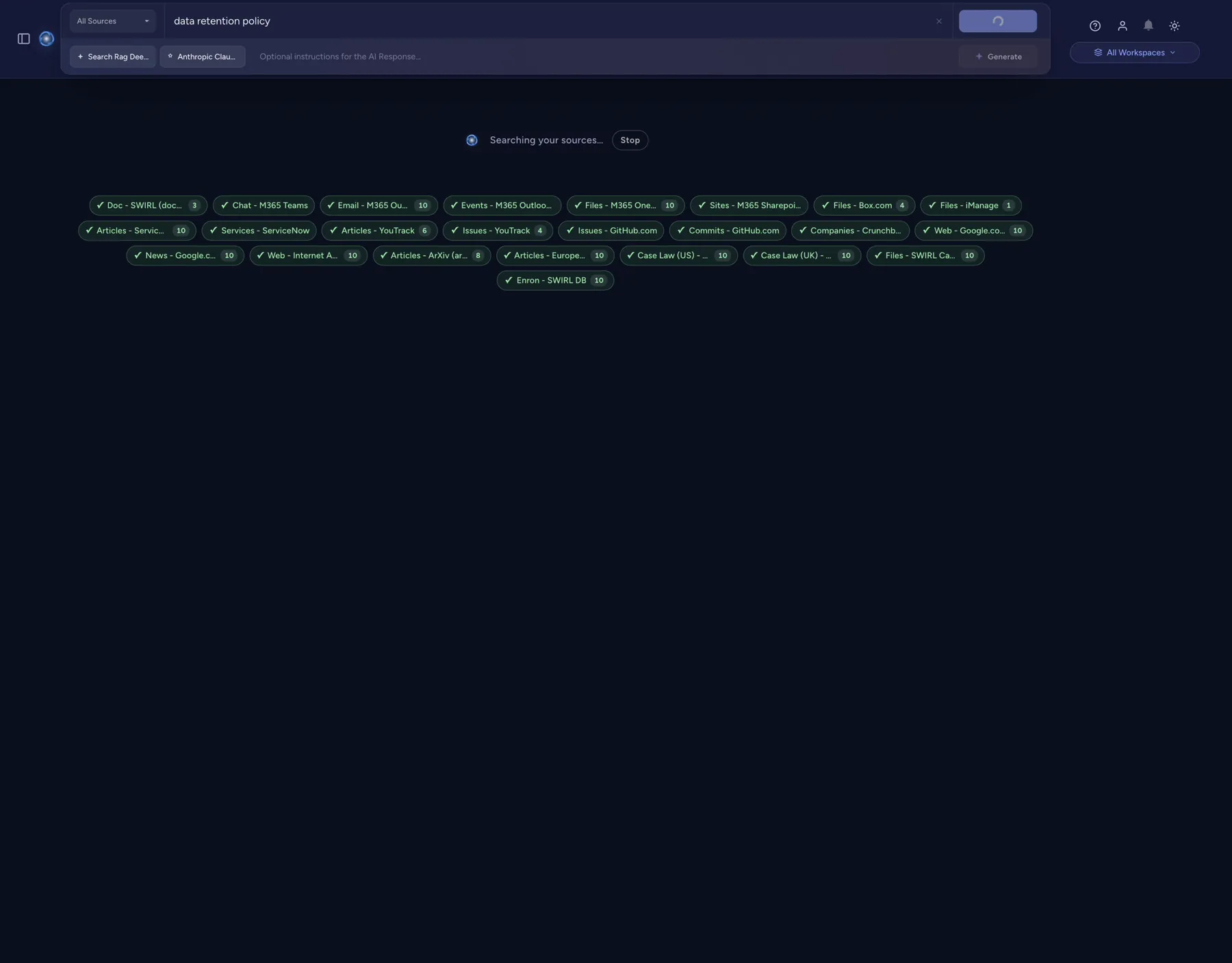
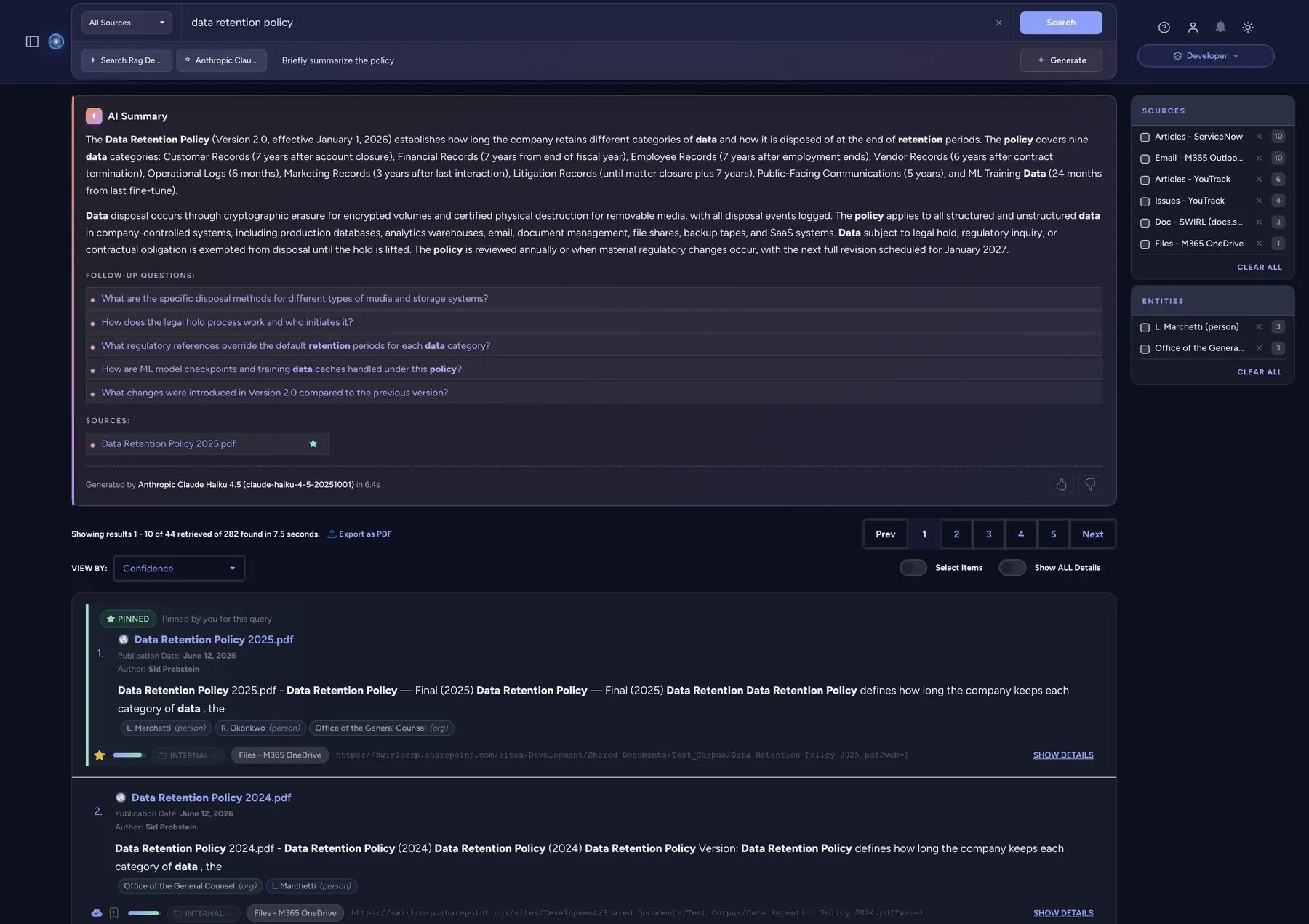
One search across every system you run. One cited answer.
The same search inside your product or agent.
| Copy-everything search | SWIRL | |
|---|---|---|
| Your content | Copied into a central index | Queried live, in place |
| Your permissions | Copied, then kept in sync | Enforced by each source, per user |
| Audit scope | One more system in scope | Nothing new holds your data |
| Data residency | A second copy, elsewhere | Stays where it is |
| Deletion | Delete, then purge the copy | Delete at the source. Done. |
| Breach surface | Everything in one place | No central store to take |
The one exception: documents you promote into the licensed Semantic Cache are stored inside your own environment.
Forty-two components, drawn from the code. The interactive map needs a wider screen.
Open the full-screen mapAny MCP client gets the same cited answers, under the same permissions.
 GitHub
 Confluence
 Jira
Jira Google Drive
 BigQuery
 Snowflake
 Elasticsearch
 PostgreSQL
 MongoDB
 Atlassian
 HubSpot
 Asana
Asana Box
Box OpenSearchGitHubConfluenceJiraGoogle DriveBigQuerySnowflakeElasticsearchPostgreSQLMongoDBAtlassianHubSpotAsanaBoxOpenSearch
 Anthropic
 Gemini
 Mistral AI
 HuggingFace
 Ollama
 DeepSeek
 Perplexity AI
 Vertex AISnowflake Cortex
 Algolia
 Redmine
 Crunchbase
 Internet ArchiveAnthropicGeminiMistral AIHuggingFaceOllamaDeepSeekPerplexity AIVertex AISnowflake CortexAlgoliaRedmineCrunchbaseInternet Archive
A 30-minute working session on your own data.
The Claude Code plugin installs SWIRL on your own data in about an hour.
Ranked results across the catalog, TechDocs, GitHub and Confluence, inside the portal.
Search and cited answers inside your customer's tenant. From $60K per year plus revenue share.