For CIOs, architects & technical evaluators

Under the hood of SWIRL 5.

The front page keeps it short. This page is for the people who have to deploy it, secure it, and sign off on it: how SWIRL reaches your systems, how it ranks without a vector database, and what it never does to your data.

Federated retrieval

One query. Every system. At once.

SWIRL fans a single query out across all your connected systems in parallel - documents, email, chat, tickets, code, the web - then re-ranks and de-duplicates what comes back. No data moves, and each system's own permissions are honored on every call.

150+ sources in parallelZero ETLPermissions enforced at source
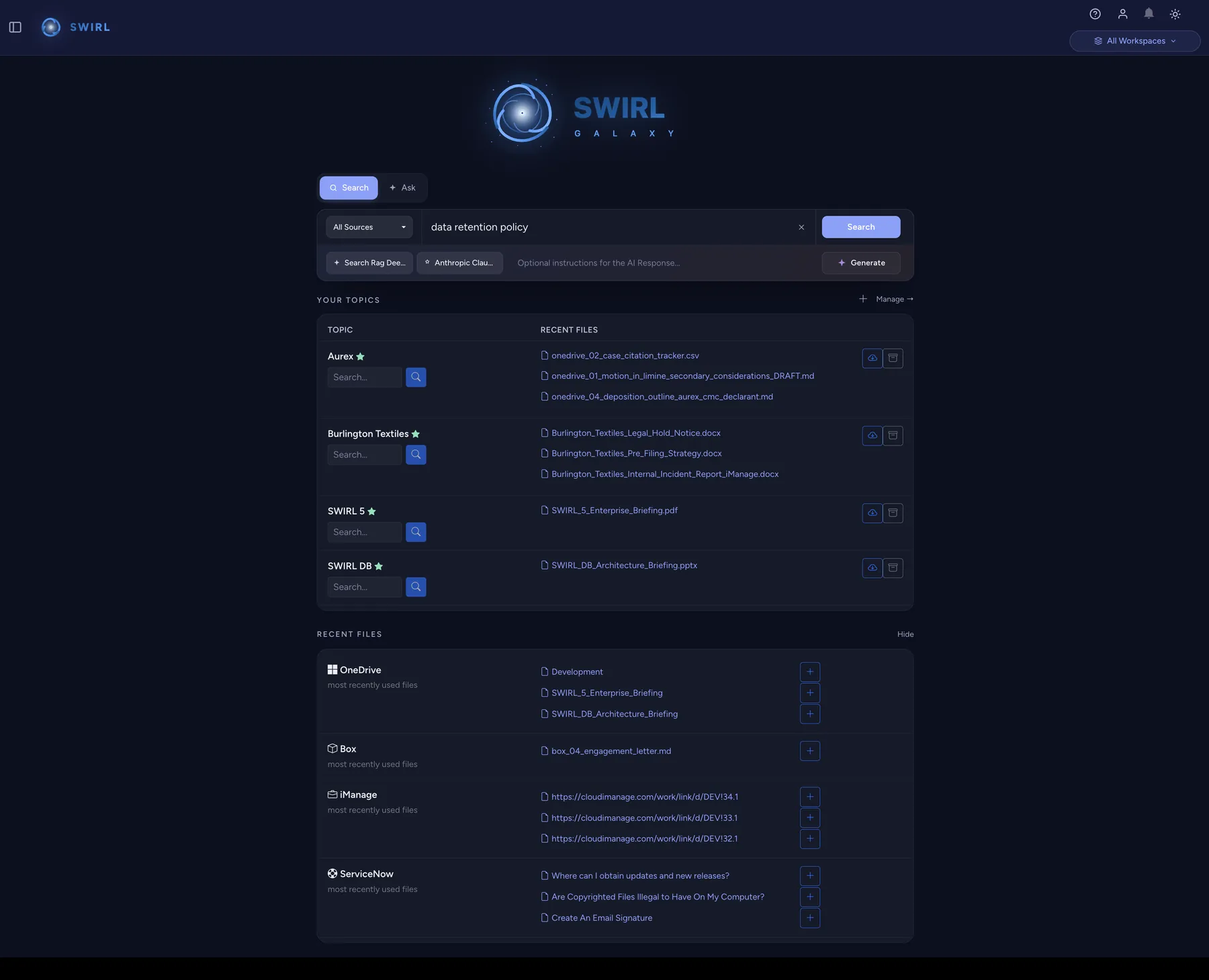
A single query entered on the SWIRL dashboard
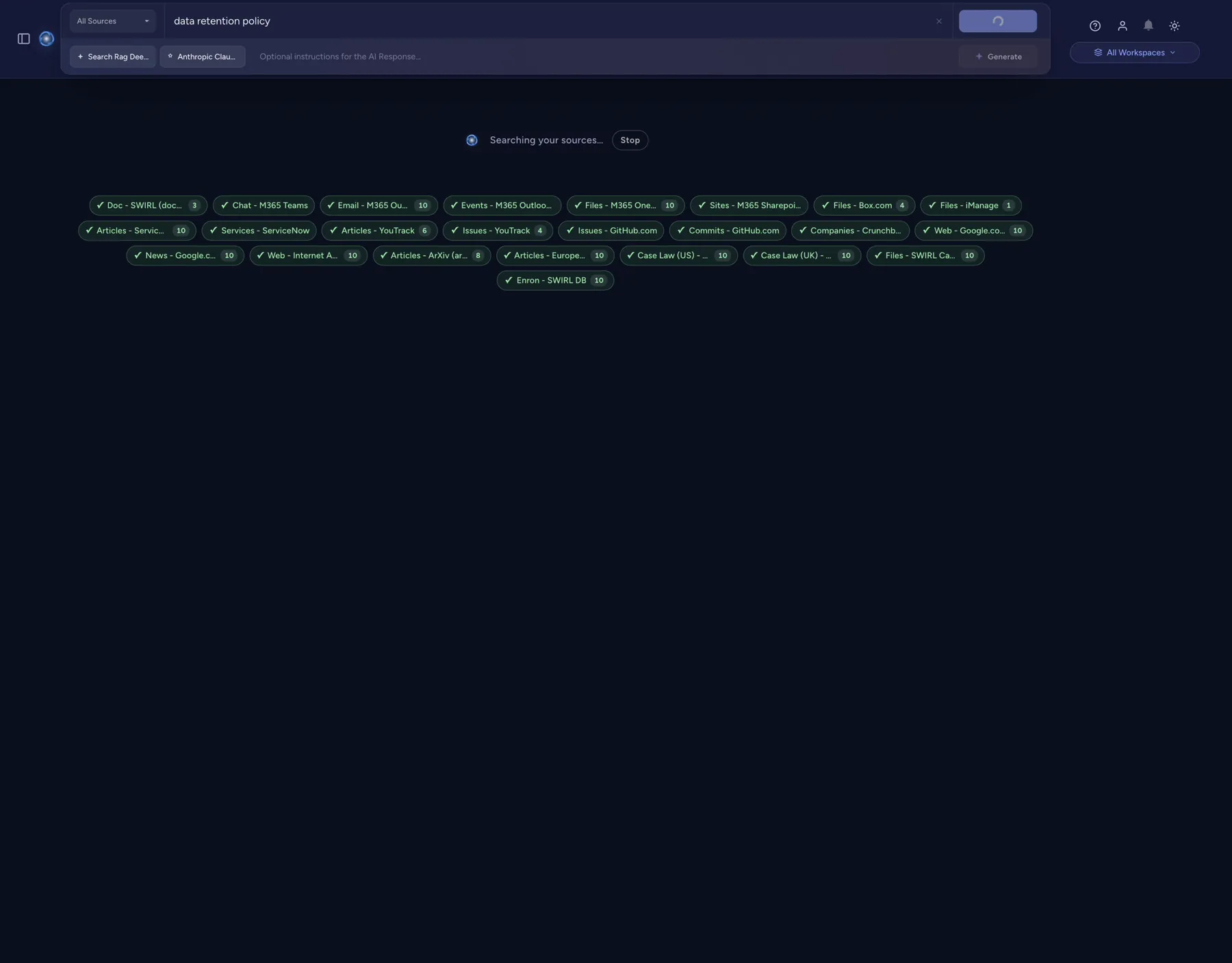
1. One query in.
SWIRL searching across every connected source in parallel
2. Every source, in parallel.
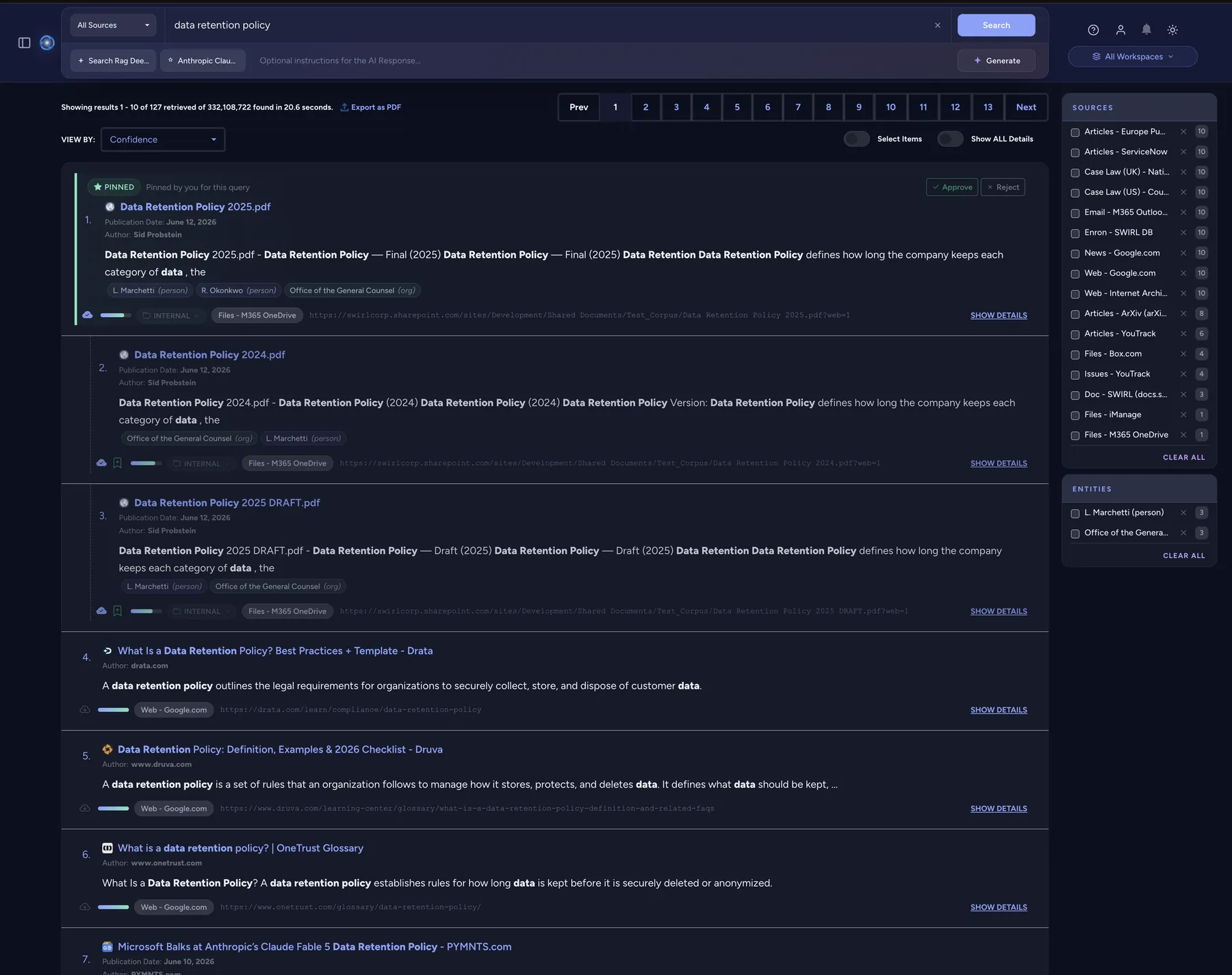
SWIRL ranked results federated from hundreds of millions of documents in seconds
3. Ranked results, in seconds.
View all 150+ connectors →
Relevance · runs locally, in your tenant

Three passes to the right answer.

Not vector distance - judgment. SWIRL ranks in three passes, and both models run locally: nothing is sent over the wire, and there is no vector database to build, secure, or keep in sync.

1
Federate & match
Keyword + BM25 across every source. Quoted phrases and exact terms are honored first - a quote must match.
2
Embedding re-rank
E5-Large-V2 embeddings with title-aware chunking, then hybrid keyword+vector fusion (RRF). No vector database to build or secure.
3
Cross-encoder re-rank
MS-MARCO cross-encoder reads the query and document together - scoring real relevance, not similarity.
E5-Large-V2MS-MARCO cross-encoderBM25 + RRFAny LLM, incl. on-prem
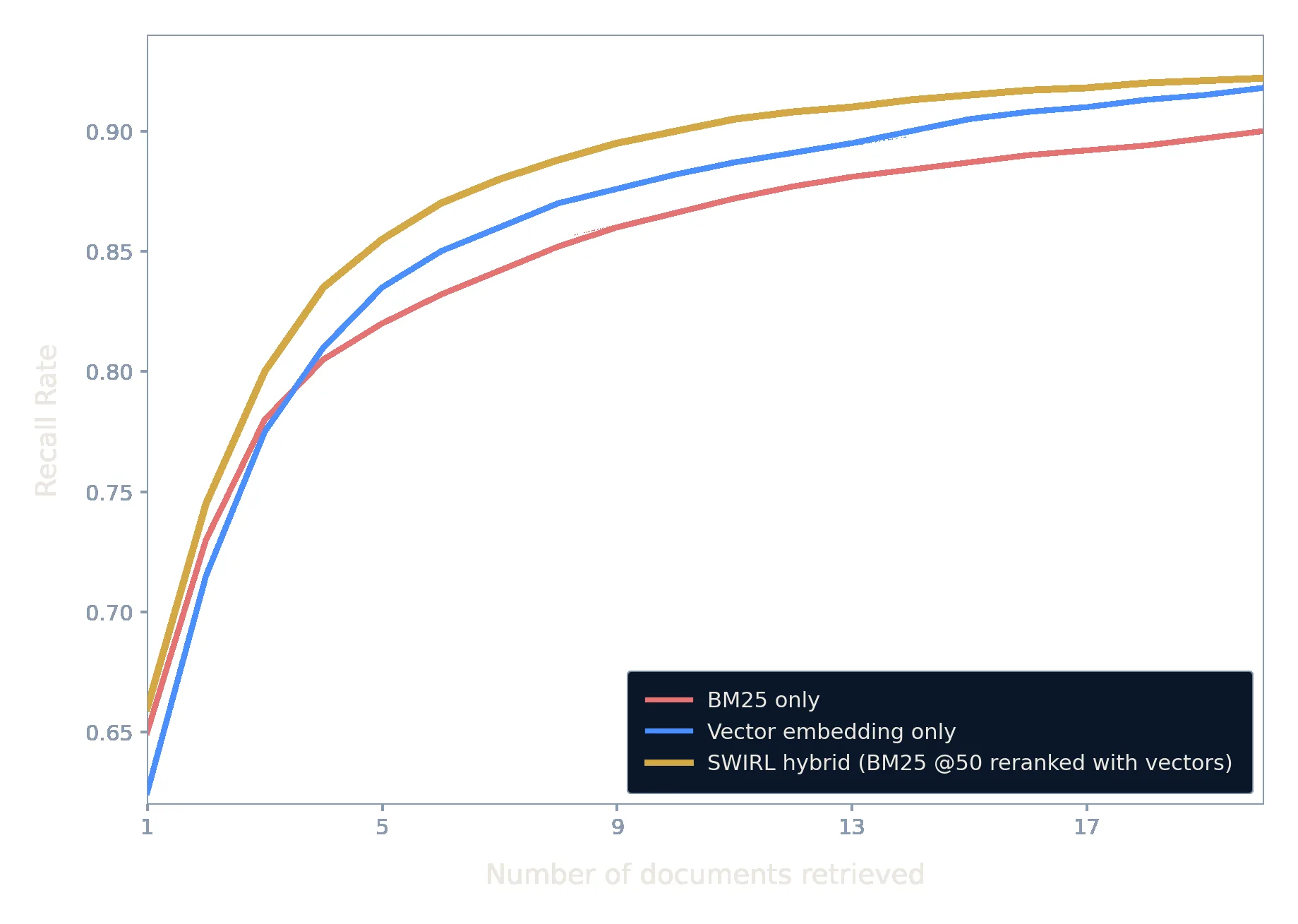
Recall-rate chart: SWIRL hybrid re-rank beats vector-only and keyword-only
Independent corroboration
Meta's XetHub benchmarked all three. Keyword-only came last, vector-only did better, hybrid re-rank won - the approach SWIRL ships by default.
"No vector database necessary." - XetHub, 2024 (archived)

Bring your architect
and your hardest question.

A 30-minute working session against a slice of your own systems: the results, the citations, and the permission boundary, on your data. You'll be talking to the person who wrote it.